What are options? Explained simply for individual investors


Lesson 1 of 6
Contents
- 1. What are options?
- How do options work (simple explanation)?
- A simple example
- What types of options are there?
- Why do investors use options?
- Opportunities and risks of options
- Conclusion - what are options really?
- Want to learn more?
- References
1. What are options?
At their core, options are contracts between two parties – a buyer and a seller. They grant the buyer the right, but not the obligation, to buy or sell an asset at a predetermined point in the future.
An option gives you the right to buy or sell an underlying asset
The value of the option depends on this underlying asset (for example, a stock or an index). That’s why options are classified as derivatives.
The underlying refers to the asset the option is based on.
The strike price is the price at which the underlying can be bought or sold through the option. It remains fixed throughout the life of the contract.
Options also have a defined expiration date.
Within this period, the buyer can exercise their right. After expiration, the option becomes worthless (1) (2) (3) (4) (5) (6)
2. How do options work? (Simple explanation)
When trading an option, a contract is created between a buyer and a seller.
The buyer acquires the right to buy or sell the underlying asset at a fixed price within a specific time frame in the future.
To obtain this right, the buyer pays a premium to the seller.
The premium is the price of the option. It depends on several factors (such as the underlying asset, time to expiration, and strike price) and fluctuates with market conditions.
Buying an option always starts with a cash outflow
The seller, on the other hand, takes on the obligation to deliver or purchase the underlying asset at the agreed price if the option is exercised.
In return, the seller receives the premium from the buyer.
Selling an option always starts with a cash inflow
The seller keeps the premium regardless of whether the buyer exercises the option or lets it expire (1)
3. A simple example
Let’s assume you own 100 shares of XYZ, currently trading at $120.
You expect the price to decline but are not entirely certain - and you don’t want to sell your shares.
So you buy a put option with a strike price of $110 and a duration of 90 days.
This option gives you the right - but not the obligation - to sell your XYZ shares at $110 at any time within the next 90 days, regardless of whether the market price is above or below that level.
Options can be thought of as a form of insurance
For this protection, you pay a premium - for example, $75 - to the seller of the option.
4. What types of options are there?
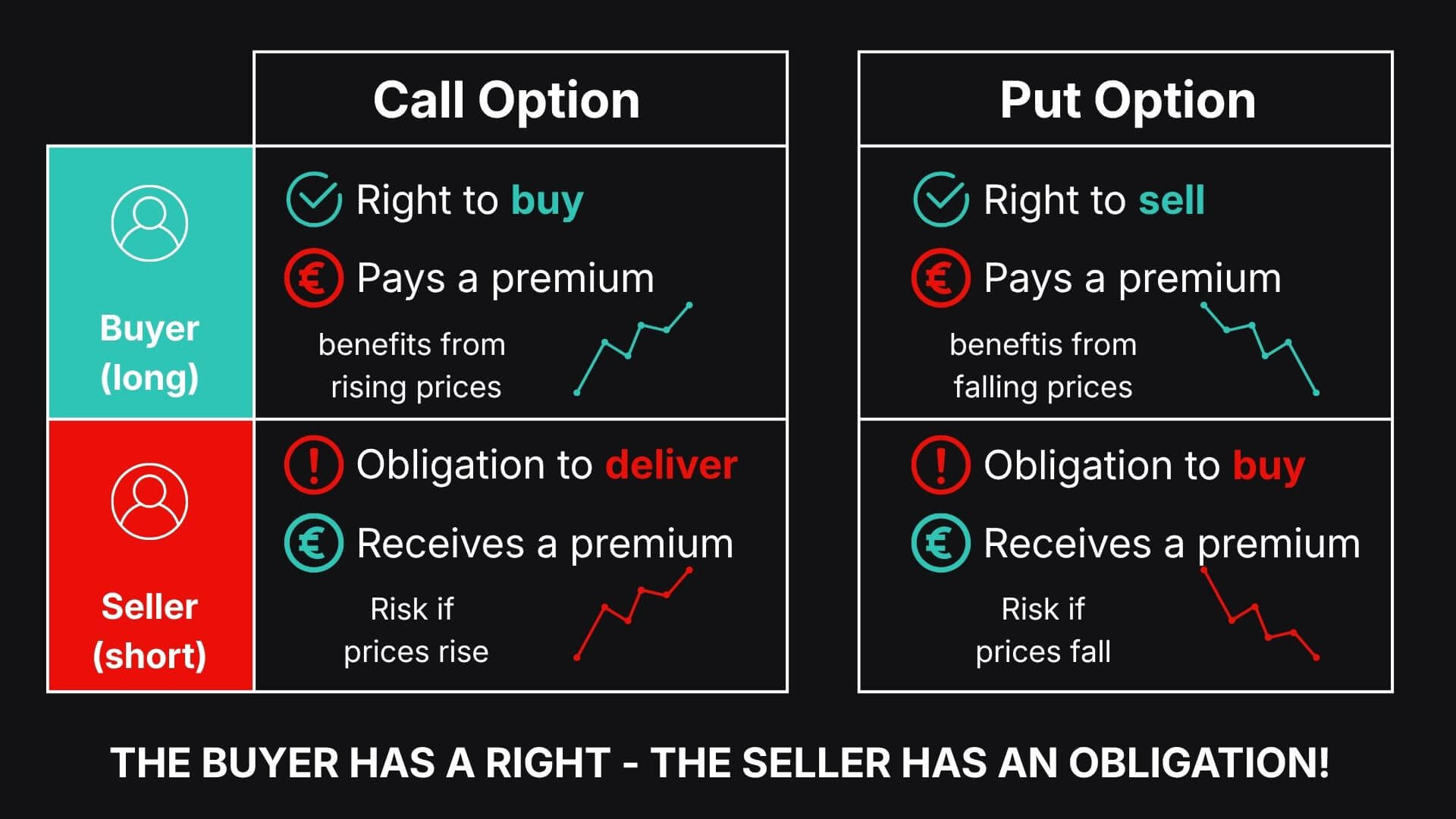
There are two main types of options:
- Call option: gives you the right to buy the underlying at the strike price
- Put option: gives you the right to sell the underlying at the strike price
In addition, there are two types of positions:
- Long position: you buy an option (call or put)
- Short position: you sell an option (call or put)
Combining option type and position results in four basic strategies (1) (2) (5) (6)
5. Why do investors use options?
Options are generally used for three main purposes:
5.1. Hedging (risk management)
Professional investors use options to protect large portfolios against risks such as price declines or market volatility.
This approach is popular because options are relatively cost-efficient and highly flexible (3) (4) (7) (8)
5.2. Speculation
Due to their leverage effect, options allow traders to control large positions with relatively little capital.
This makes them attractive for speculative strategies (1) (2) (9)
5.3. As building blocks for structured products
Banks often use options in combination with assets like stocks or indices to create structured products for retail investors.
Examples include:
- Discount certificates (lower entry price, capped upside)
- Reverse convertibles (fixed yield with equity risk) (9) (10) (11)
6. Opportunities and risks of options
Options are highly versatile and offer a wide range of possibilities - but they also involve risks you should understand.
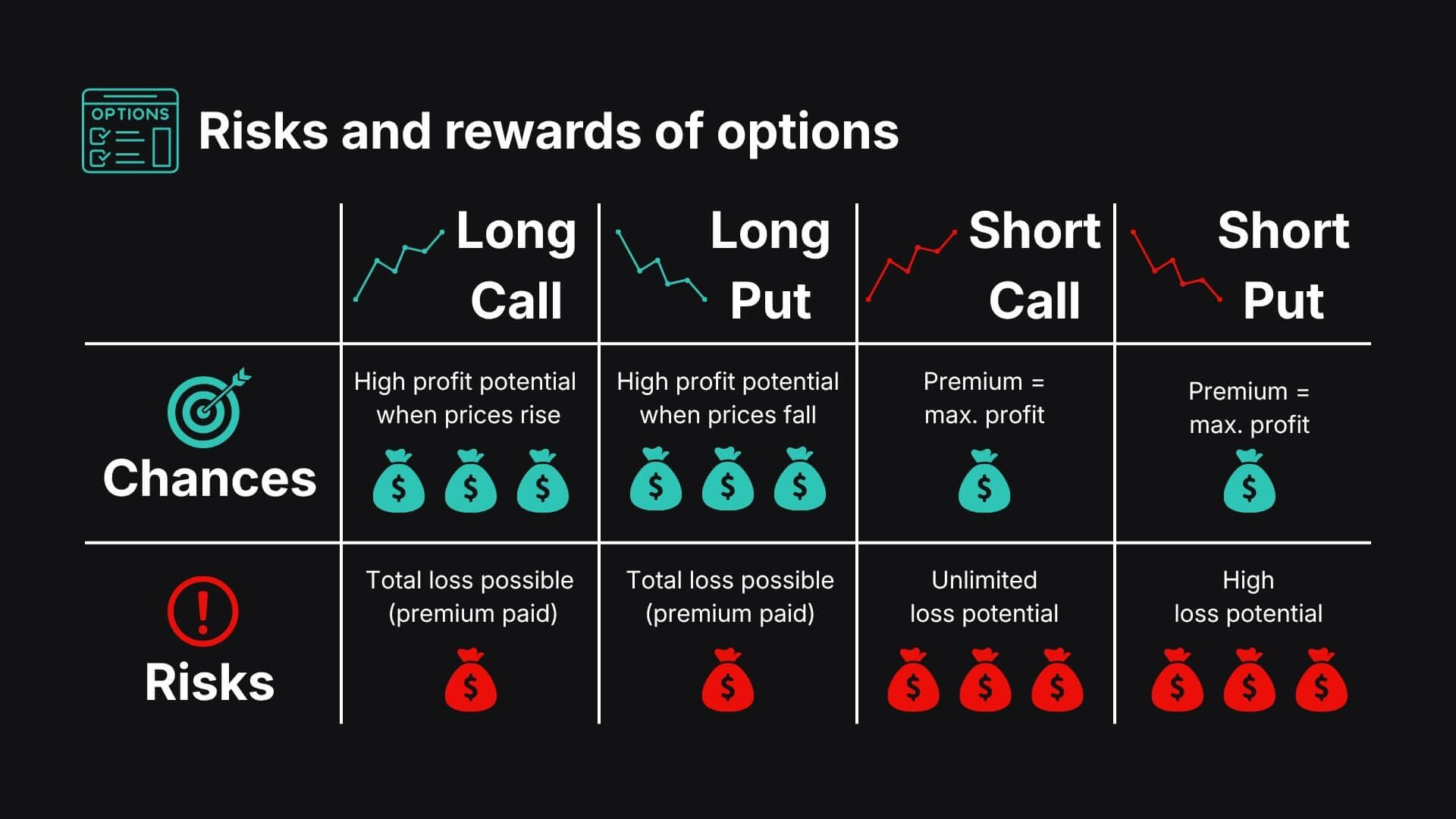
The following overview provides a first impression:
Long positions
Long positions offer the potential for high returns with relatively low capital investment.
This is known as leverage, and it can significantly amplify returns.
However, it’s important to understand that with the wrong strategy, the entire premium paid can be lost - resulting in a 100% loss.
Short positions
In short positions, the maximum profit is limited to the premium received.
At the same time, the potential losses can be substantial—or even unlimited.
At first glance, this may seem unattractive.
However, when used correctly, short strategies can achieve high probability outcomes and play an important role in a structured approach to trading.
7. Conclusion – What are options really?
When I first started trading options many years ago, I thought I had discovered the holy grail of investing.
I knew very little about options, took large risks - and made spectacular gains.
Only to lose it all five weeks later with a single trade.
That’s when I began to understand the true nature of options:
Options offer powerful opportunities - if you manage the risks correctly
So I studied, tested, and eventually developed a structured approach (my own) to trading options profitably.
Today I know:
Options are not a shortcut to quick wealth
But they are one of the most flexible tools available to individual investors - if you understand how to use them.
8. Want to learn more?
If you want to understand how to apply options in practice, continue with the next lesson:
"What is a Long Call?" (Lesson 2 of 6)
9. References
(1) Wu, J., Wang, Y., Zhu, M., Zheng, H., & Li, L. (2023). Exotic option pricing model of the Black–Scholes formula: a proactive investment strategy. , 11.
https://doi.org/10.3389/fphy.2023.1201383.
(2) Wen, W., Yuan, Y., & Yang, J. (2021). Reinforcement Learning for Options Trading. Applied Sciences.
https://doi.org/10.3390/app112311208.
(3) Ye, B., Pu, H., Song, Y., & Jiang, J. (2025). Design and pricing of an option product for China's green electricity-carbon medium and long-term markets. Environmental Impact Assessment Review.
https://doi.org/10.1016/j.eiar.2025.107804.
(4) Zulfiqar, N., & Gulzar, S. (2021). Implied volatility estimation of bitcoin options and the stylized facts of option pricing. Financial Innovation, 7.
https://doi.org/10.1186/s40854-021-00280-y.
(5) Alaje, A., Olayiwola, M., Adedokun, K., Adedeji, J., Oladapo, A., & Akeem, Y. (2023). The modified homotopy perturbation method and its application to the dynamics of price evolution in Caputo-fractional order Black Scholes model. Beni-Suef University Journal of Basic and Applied Sciences, 12.
https://doi.org/10.1186/s43088-023-00433-1.
(6) Carbonneau, A., & Godin, F. (2020). Equal risk pricing of derivatives with deep hedging. Quantitative Finance, 21, 593 - 608.
https://doi.org/10.1080/14697688.2020.1806343.
(7) Carbonneau, A. (2020). Deep hedging of long-term financial derivatives. Insurance: Mathematics and Economics.
https://doi.org/10.1016/j.insmatheco.2021.03.017.
(8) Y., Pan, D., & Wang, T. (2020). Exchange options under clustered jump dynamics. Quantitative Finance, 20, 949 - 967.
https://doi.org/10.1080/14697688.2019.1704045.
(9) Xu, F., & , J. (2023). Intelligent option portfolio model with perspective of shadow price and risk-free profit. Financial Innovation, 9, 1-28.
https://doi.org/10.1186/s40854-023-00488-0.
(10) Chen, R., Zhou, H., Jin, C., & Liu, J. (2020). Discount or premium? Pricing of structured products: An analysis of Chinese market. International Review of Financial Analysis, 70, 101493.
https://doi.org/10.1016/j.irfa.2020.101493.
(11) Madan, D., & Wang, K. (2021). Pricing Product Options and Using Them to Complete Markets for Functions of Two Underlying Asset Prices. Journal of Risk and Financial Management.