What is a Long Call? The Simplest Way to Get Started with Options Trading

Lesson 2 of 6
Contents
- What is a Long Call?
- How does a Long Call work?
- A simple example
- The Leverage Effect - explained simply
- When does a Long Call make sense?
- Opportunities and Risks
- Common Mistakes
- Long Call vs. Buying Stocks
- Conclusion: How is a Long Call suitable for?
- Want to learn more?
- References
Many retail investors start trading options with long calls — and lose money.
Not because the strategy itself is bad, but because it is misunderstood.
1. What is a Long Call?
A long call is one of the four basic options trading strategies.
Long call: buying a call option
It gives the buyer the right to purchase the underlying asset (e.g., a stock or an index) at a predetermined price within a specified period of time.
This right exists regardless of the current market price of the underlying (1) (2)
2. How does a Long Call work?
A long call involves two parties entering into an options contract under the following terms:
The Option Buyer
As the buyer of the call option, you receive the right to purchase the underlying asset at a fixed strike price during the option’s lifetime.
You are buying a right, not an obligation — that’s why it’s called an option.
To obtain this right, you pay a fee to the seller of the option, known as the option premium.
The Option Seller
The seller (your counterparty) takes on the obligation to deliver the underlying asset at the strike price if you choose to exercise the option.
In return, they receive the premium — which they keep regardless of whether the option is exercised or expires worthless.
3. A simple example
Let’s assume you’re interested in stock ABC, currently trading at $500, and you expect prices to rise.
Instead of buying the stock directly, you buy a call option with a strike price of $505 a time to expiration of 90 days.
This option gives you the right to:
- buy the stock at $505
- within the next 90 days
- but not the obligation to do so
For this right, you pay a premium — say $100.
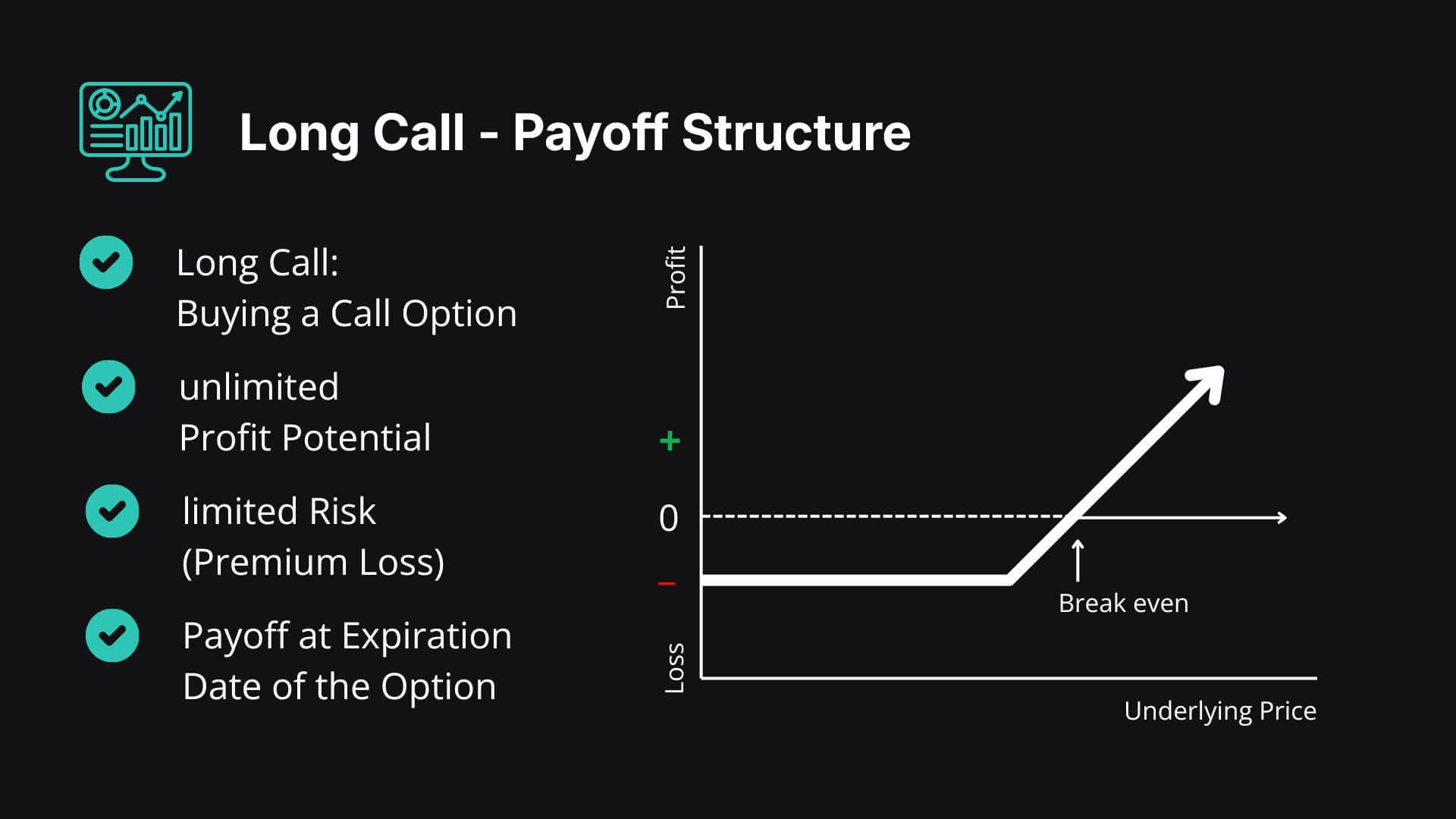
Long Call Payoff Structure (1) (3)
You incur a loss if…
If the stock trades at $505 or below, your option expires worthless.
Your loss equals the premium paid ($100).
Between $505 and $506, you still have a small loss.
Example:
- Buy at $505 via the option
- Sell at $505.50 in the market
- Profit: $50
- Premium paid: $100
Leads to a net loss: $50
Note: One option contract typically represents 100 shares
You break even when…
At a stock price of $506:
- You buy 100 shares at $505
- Sell them at $506
- Gain: $100
- Premium paid: $100
Lead to Break-even
You make a profit when…
If the stock rises above $506, you generate profit.
The higher the stock price rises, the larger your profit becomes
4. The Leverage Effect — explained simply
Options provide leverage, meaning they can generate a higher percentage return.
The reason: lower capital required. (1) (4)
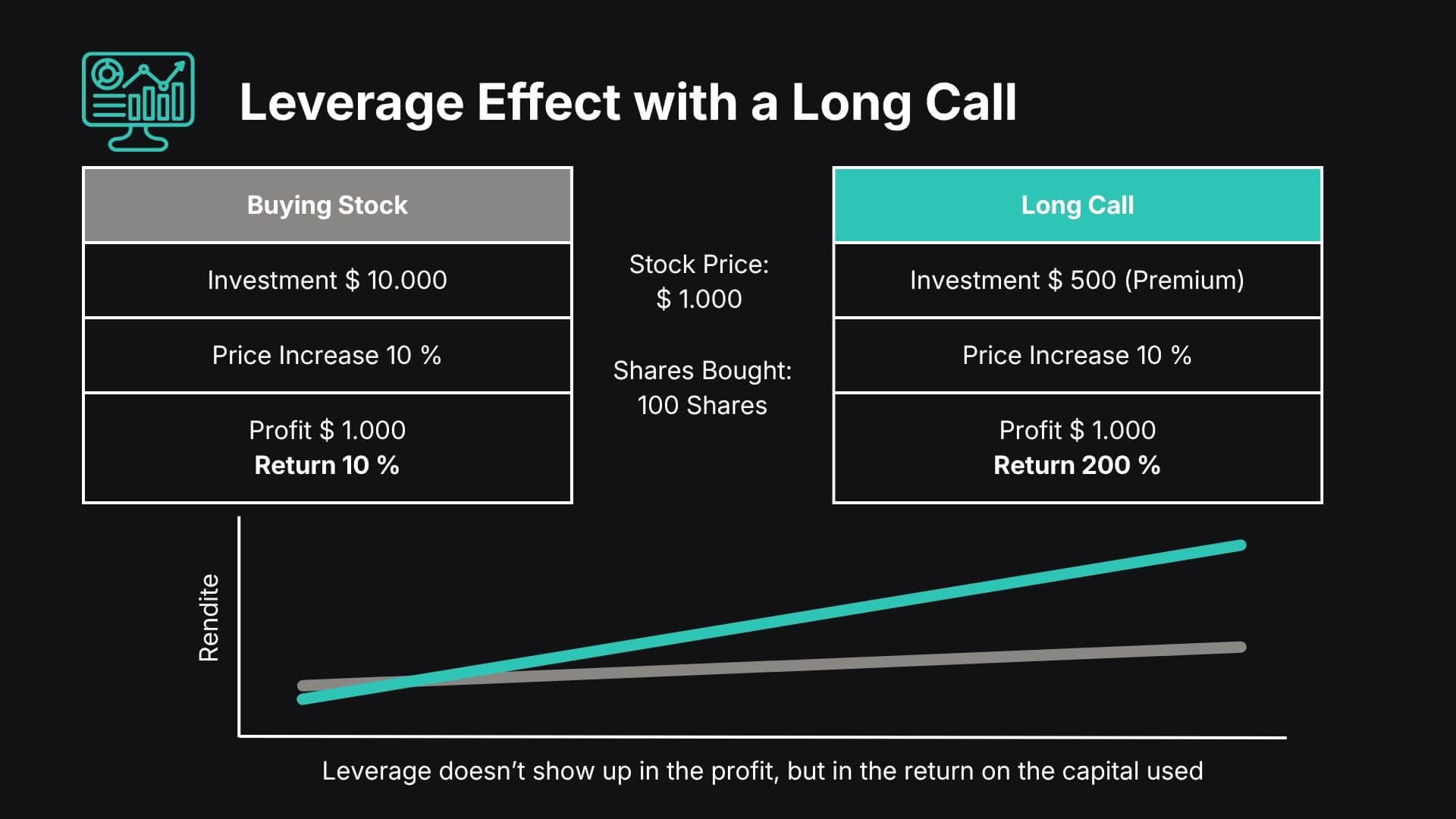
- With a call option, you only pay the premium
- With stocks, you must pay the full purchase price
The same absolute profit can result in a much higher return on capital when using options.
5. When does a Long Call make sense?
A long call can make sense if you:
You can also allocate a small portion of your portfolio (e.g., 10%) to options to potentially enhance returns (4)
Long calls are particularly useful if your goal is to speculate on outsized gains using leverage (5) (6)
6. Opportunities and Risks
Opportunities
- Potential for outsized gains in strong upward markets (5) (1) (4)
- Defined risk limited to the premium paid (1) (7)
Risks
- Total loss of capital (premium)
Occurs if the price does not rise fast enough or far enough (1) (8)
7. Common Mistakes
7.1. Chasing cheap options
Many traders choose options based on low price alone.
These are often far out-of-the-money, requiring strong and fast price moves.
If that doesn’t happen → option expires worthless (9) (10)
7.2. Ignoring the long-term effect
Occasional big wins are often offset by repeated small losses.
Over time, this reduces the expected return (9)
7.3. Lack of understanding
Without knowledge of:
- pricing
- costs
- probabilities
traders tend to select options with poor risk-reward profiles (10) (11)
8. Long Call vs. Buying Stocks
Long calls are often used as an alternative to buying stocks (1) (2) (4)
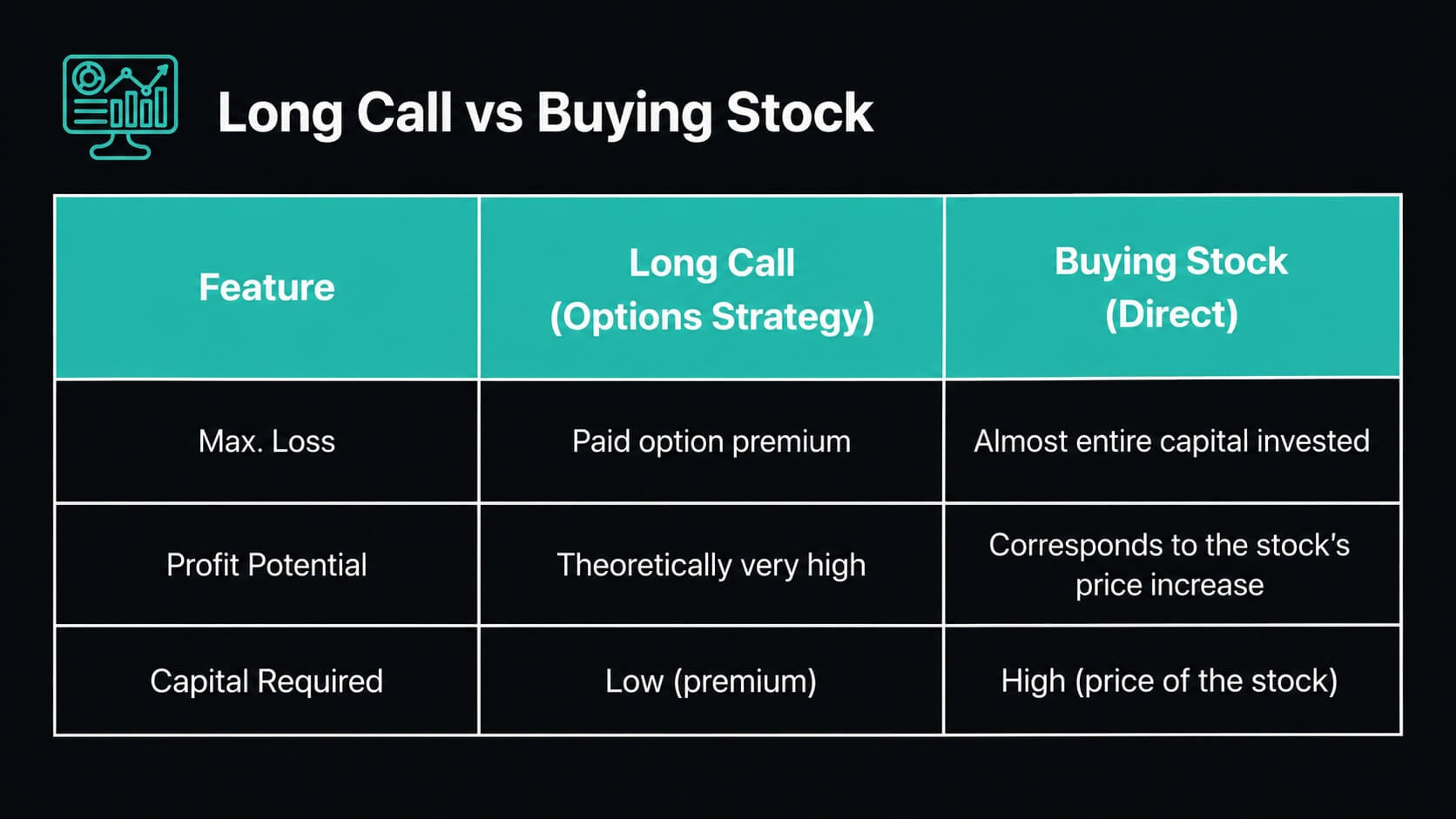
- If you expect a strong short-term move, a long call can be more attractive
- If you aim for long-term investing (dividends, steady growth), buying stocks is usually the better choice
9. Conclusion: Who is a Long Call suitable for?
For me, a long call is a tool to speculate consciously with limited capital and potentially achieve high returns.
However, this requires a solid understanding of how the strategy works and where the risks lie.
If you understand the leverage, you can use it intentionally.
If you don’t, you will end up paying for it.
10. Want to learn more?
To strengthen your foundation, check out:
“What Are Options?” (1 of 6)
Next lesson:
“What Is a Short Put?” (3 of 6)
11. References
(1) Yuan, B. (2022). Investment Strategies for Retail Investors Using Put option and Covered Call. BCP Business & Management.
https://doi.org/10.54691/bcpbm.v29i.2300
(2) Cuthbertson, K., Nitzsche, D. and O'Sullivan, N. (2019). Options Markets. In Derivatives (eds K. Cuthbertson, D. Nitzsche and N. O'Sullivan).
https://doi.org/10.1002/9781119595663.ch14
(3) P., S., E., G., , R., L., K., & Matha, R. (2022). Choosing the right options trading strategy: Risk-return trade-off and performance in different market conditions. Investment Management and Financial Innovations.
https://doi.org/10.21511/imfi.19(2).2022.04
(4) Trainor, W., Chhachhi, I., & Brown, C. (2019). Leaping Black Swans. , 28, 64 - 76.
https://doi.org/10.3905/joi.2019.28.1.064
(5) Ge, L., Lin, T., & Pearson, N. (2016). Why Does the Option to Stock Volume Ratio Predict Stock Returns. Journal of Financial Economics, 120, 601-622.
https://doi.org/10.1016/j.jfineco.2015.08.019
(6) Liu, Y., & Piccotti, L. (2024). Synthetic long stock and option trading: Evidence from stock splits. Journal of Financial Research.
https://doi.org/10.1111/jfir.12404
(7) P., S., E., G., Acharya, R., G, V., & Matha, R. (2022). Are Options Trading Strategies Really Effective for Hedging in the Indian Derivatives Market?. Cogent Economics & Finance, 10.
https://doi.org/10.1080/23322039.2022.2111783
(8) Thomsett, M. (2013). Strategy # 2: Long/Short-Call Strategy, Uncovered Short Side. , 213-225.
https://doi.org/10.1057/9781137344113_12
(9) Buckle, D. (2022). The Impact of Options on Investment Portfolios in the Short-Run and the Long-Run, with a Focus on Downside Protection and Call Overwriting. Mathematics.
https://doi.org/10.3390/math10091563
(10) Kang, C., Kim, D., Kim, J., & Lee, G. (2022). Informed trading of out‐of‐the‐money options and market efficiency. Journal of Financial Research.
https://doi.org/10.1111/jfir.12274
(11) Zhou, Y. (2021). Option trading volume by moneyness, firm fundamentals, and expected stock returns. Journal of Financial Markets, 100648.